Umbraco AI use cases: which are worth the investment?

calendar icon 24 September 2026
clock icon 7 minutes read
Earth in outer space
Share article
Explore more insights
Interested in how we approach similar challenges? Discover other articles on:

AI in CMS platforms is no longer unusual, but not every integration delivers enough value to justify its cost. For website owners and marketing teams, the real question is not whether AI can be added to Umbraco, but where it can improve customer experience, reduce manual work or support better decisions.

How do you distinguish a useful AI application from an expensive experiment? It depends on the business problem, the available content and data, the frequency of the task and whether the result can be measured.

This article examines four practical Umbraco AI use cases: search, content operations, support assistants and personalisation. For each one, we consider the business case and the effort involved, including when a simpler solution may be enough.

How to evaluate an Umbraco AI use case

Before choosing an AI feature, define the business problem it should solve. Consider how often the problem occurs and whether it has a noticeable effect on costs or customer behaviour. If the impact cannot be measured, it will also be difficult to assess the return.

The quality of the available content and data matters as much as the technology. The estimate should cover the initial implementation as well as AI provider usage and the work required after launch. In some cases, improving existing website functionality will deliver a better return with less effort.

Use case

Potential business value

Implementation effort

Best suited for

Example metric

AI-powered search

Better product and content discovery

Medium

Large catalogues and knowledge bases

Unsuccessful search rate

AI content operations

Faster content production

Low to medium

Multi-site or content-heavy platforms

Time per published page

Support assistant

Faster access to reliable answers

Medium to high

Businesses with recurring support questions

Resolution time

AI personalisation

More relevant customer journeys

High

Websites with sufficient traffic and customer data

Conversion by segment

Implementation effort also depends on the current platform version. At the time of writing, the official Umbraco AI packages require Umbraco CMS 17.1 or later and .NET 10. Older installations may need an upgrade or a custom integration before these features can be introduced. Projects still running on Umbraco 8 require a staged migration to a supported version.

A limited pilot allows the business to compare the new approach with the current process before making a broader commitment. The findings can then inform whether further implementation would be worthwhile.

Note: The illustrations below use a fictional demo store to show how AI features might appear in the Umbraco backoffice and on a customer-facing website. The final interface and functionality would depend on the project.

AI-powered search in Umbraco

Search becomes a business problem when customers cannot find relevant products or information, even though that content exists on the website. AI-powered search can improve discovery, but its value depends on the size of the platform and how people use it.

What problem does semantic search solve?

Traditional search primarily relies on matches between a user’s query and the words or phrases indexed on the website. Synonyms and fuzzy matching can improve it, but the quality of the results still depends largely on how closely the query reflects the terminology used in the content.

Semantic search focuses on meaning. A customer can describe a need in natural language, such as “a lightweight camera for travelling”, without knowing the product name or category used on the website. On multilingual websites, it can show content from the relevant language version.

Umbraco AI Search

Illustrative semantic search experience for a fictional retailer: a natural-language query surfaces relevant products and related guidance.

When does AI-powered search make business sense?

Semantic search is particularly valuable for large product catalogues and knowledge bases, where visitors may describe the same need in different ways. It deserves attention when failed searches are common or when finding the right content has a direct effect on sales. Focus Nordic illustrates this type of environment. Its product information and editorial content span more than ten local websites, making exact terminology less predictable across markets.

When may conventional search be enough?

A smaller website with clear navigation may not need semantic search. If visitors already know the service or product name, a well-configured keyword search can remain effective.

It is also worth checking whether the problem comes from the search engine itself. Better product descriptions or more useful filters may improve the experience without adding another technology layer.

What does implementation require?

The Umbraco.AI.Search package creates vector embeddings for published content and media and makes semantic results available through the Umbraco Search API. It works alongside traditional search and requires an embedding-capable AI provider. The customer-facing search interface still needs to be designed and integrated into the website.

For multilingual websites, separate embeddings are created for each culture. If protected content is included, the implementation must pass the appropriate access context so Umbraco can filter the results. Relevance and response times should be tested with real queries before launch.

How can the result be measured?

Start with the current share of searches that return no useful result. It is also important to see whether visitors continue to a product or content page after searching. A pilot can compare the current search with semantic search using the same set of queries. This shows whether the improvement is substantial enough to justify implementation and ongoing operation.

AI content management in Umbraco

Content teams often spend a large part of their time on routine work around publishing. AI content management can reduce this workload, but it works best as part of a controlled editorial process rather than as an independent content creator.

What problem does content AI solve?

AI can prepare first drafts of meta text or page summaries. It can also suggest improvements based on the content already available in Umbraco. This is useful when editors repeat the same task across many pages. Instead of starting from an empty field, they review a prepared suggestion and decide whether it is suitable for publication.

When does AI content automation make business sense?

AI content management fits teams that handle a high volume of pages or coordinate updates across several markets. The clearest benefit is a shorter publishing cycle, especially when editors repeatedly perform the same drafting, summarisation or optimisation tasks across large volumes of content.

When may a standard content workflow be enough?

A business that publishes only a few pages each month may gain little from AI content automation. Templates and clearly configured content fields can already make the process efficient.

The same applies to multilingual workflows. UKAD, for example, uses Translation Manager in Umbraco to manage translated content within the CMS. A specialised workflow like this may be more predictable than introducing AI into every stage of translation.

What does implementation require?

The Umbraco AI features for editors include reusable Property Prompts that appear next to selected content fields. They are configured in advance for specific tasks, such as shortening an introduction or improving readability, so editors do not need to write a new prompt each time.
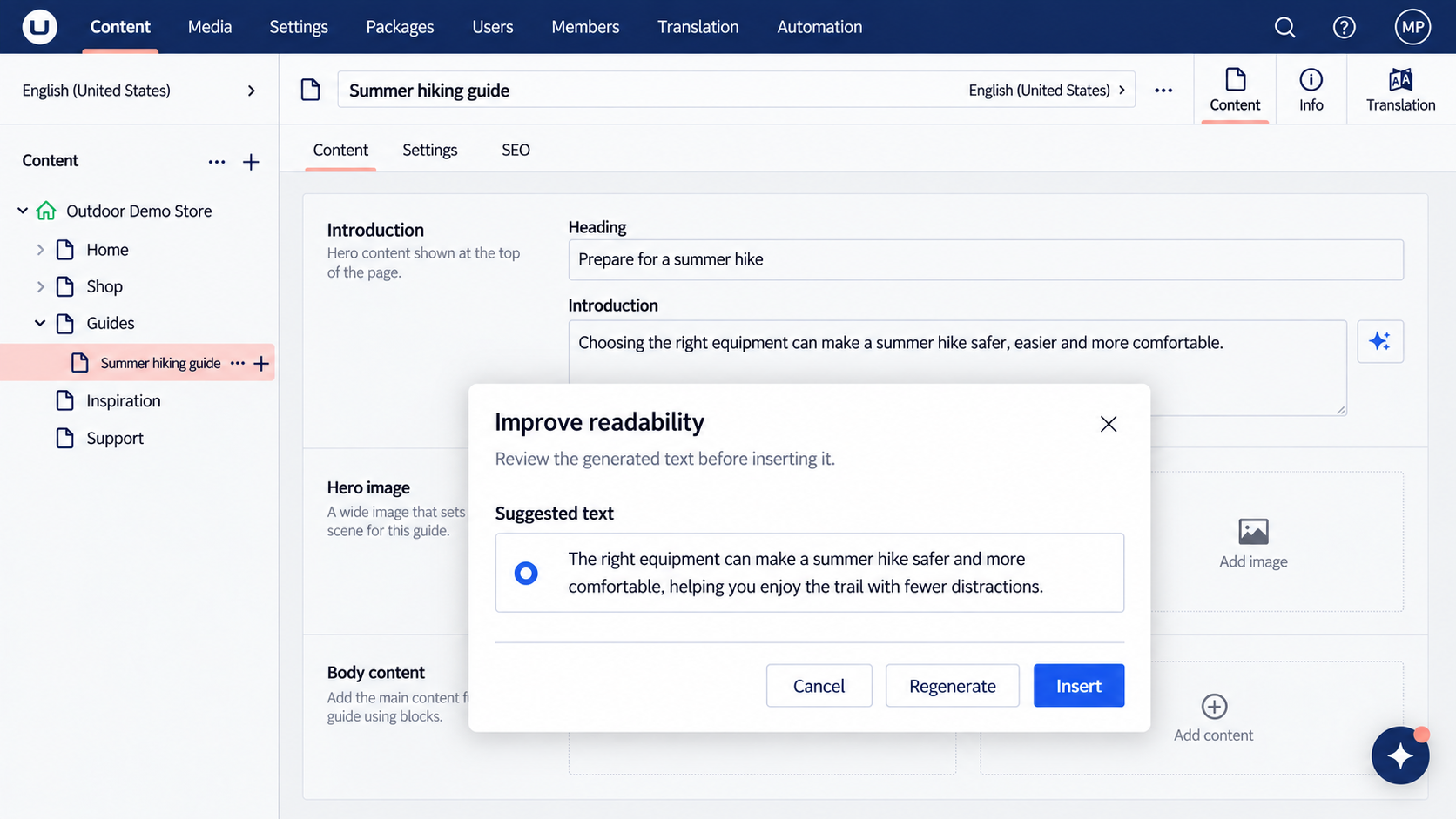

Property Prompt Illustrative Property Prompt workflow in the Umbraco backoffice: an editor reviews generated text before inserting it.

Each prompt should reflect the purpose of the field and the expected tone. Editors remain in control: they can review, regenerate or reject suggestions before applying them to a field, while publishing remains a separate editorial action.

For broader editorial tasks, Umbraco Contextual Copilot provides a chat interface inside the backoffice. It works with the content or media item currently open and can suggest changes to specific fields.
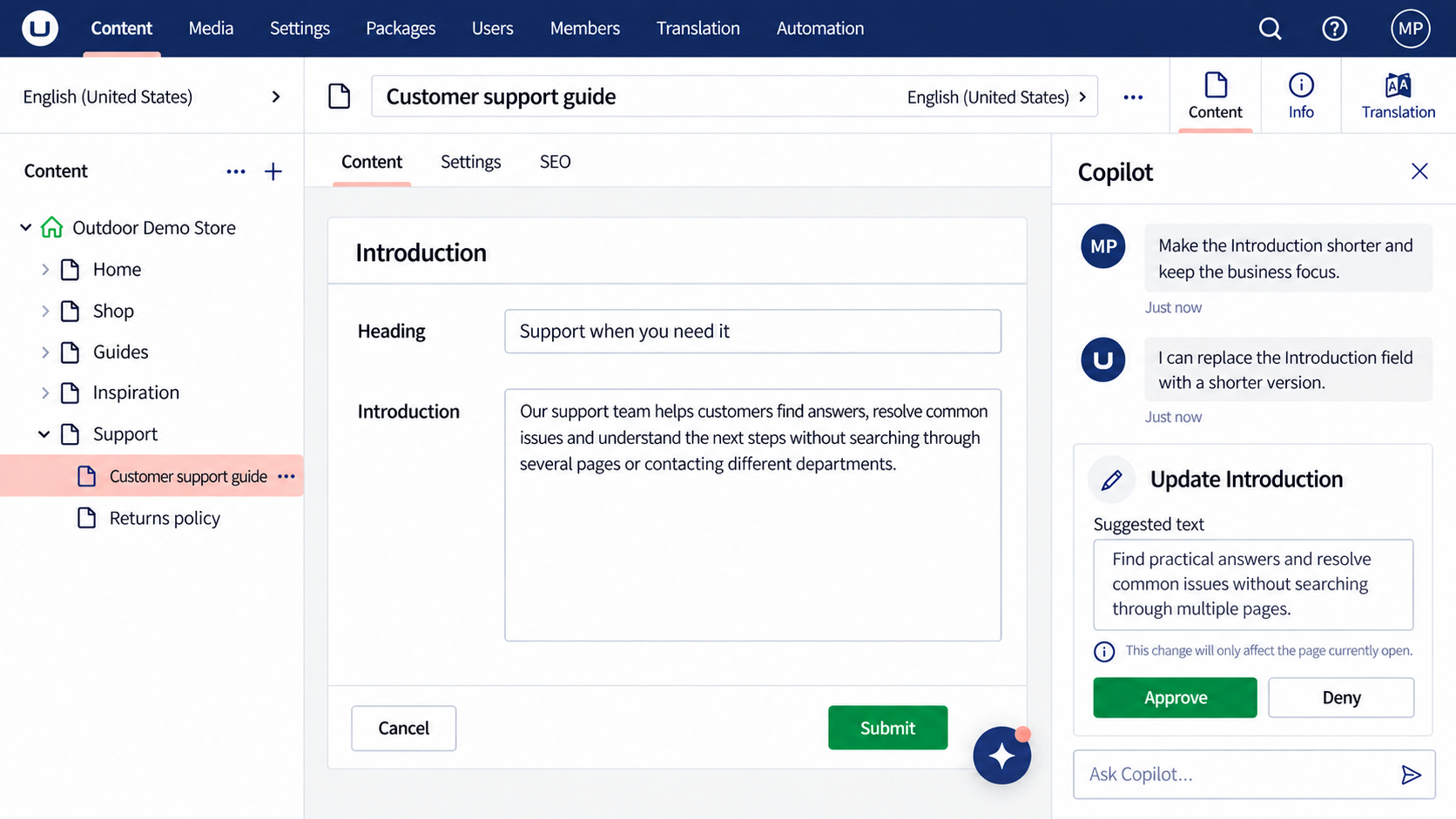

Copilot AI Illustrative Umbraco backoffice workflow: Copilot suggests an update to the current field and asks for approval before applying it.

Both tools send content to the AI provider selected by the organisation. The business therefore needs to decide what information may be processed and configure appropriate guardrails before introducing these features to editors.

How can the result be measured?

Start by measuring how long a typical page takes to prepare and approve. The same process can then be tested with AI assistance. The result should show whether editors complete the work faster without creating additional review effort. The acceptance rate of AI suggestions can also indicate whether the workflow is genuinely useful or simply adds another step.

AI support assistants and chatbots in Umbraco

An AI chatbot for a website can give customers faster access to information that already exists in Umbraco. A similar assistant can work internally, helping support teams find an approved answer without searching through multiple pages or documents.

What problem does a support assistant solve?

Customers often ask the same questions in different ways. A traditional FAQ only helps when visitors can find the relevant page and recognise that it contains the answer.

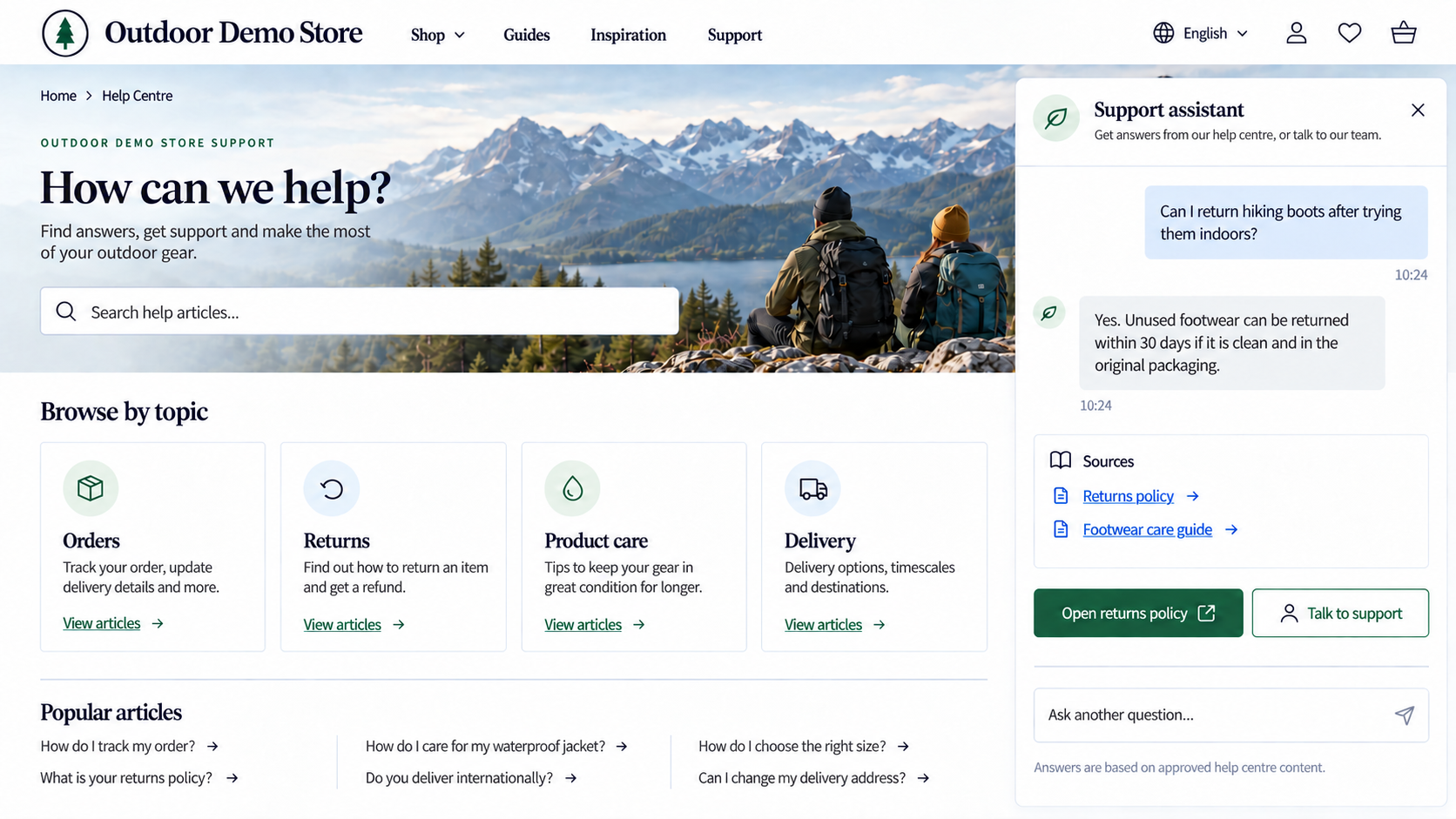
An AI support assistant provides a conversational way to access that information. It can answer directly from approved content or guide the user to the relevant page. An internal assistant serves a related purpose by helping employees retrieve information while they handle a request.

Umbraco AI Assistant Illustrative support assistant for a fictional retailer: the answer is grounded in approved help-centre content and links to its sources.

When does an AI support assistant make business sense?

A support assistant can be worthwhile when recurring questions take up a noticeable share of the team’s time. It works best when the answers already exist in a maintained knowledge base but are difficult for customers or employees to locate quickly. In this setup, Umbraco remains the source of approved content, while the assistant offers a more direct way to access it.

When may standard support be enough?

A business with a low volume of enquiries may not need an AI assistant for its website. A clearer FAQ or an improved support form may solve the problem with less complexity.

Human support should also remain available when a request requires judgement or access to sensitive customer information. In these situations, the assistant can collect context and direct the request to the appropriate person rather than attempt to resolve it independently.

What does implementation require?

A public-facing support assistant is a custom integration rather than a ready-made feature in the official Umbraco AI add-ons. It needs to connect the AI model to approved Umbraco content and keep that source information up to date. The implementation must respect content permissions and define what happens when a reliable answer is unavailable.

Testing should use real support questions, including cases where the assistant needs to hand the conversation over to a person. UKAD’s AI assistant development services cover assistants that use company data and retrieval-augmented generation to produce grounded responses.

How can the result be measured?

Begin with the current response time for recurring questions and the share of requests that require support-team involvement. These figures provide a baseline for assessing the assistant. A pilot should also review the quality of the answers, not only the number of conversations handled. If employees still need to correct most responses, the assistant may be moving work rather than reducing it.

AI personalisation in Umbraco

Umbraco already supports segment-based personalisation through Umbraco Engage. AI-powered personalisation goes further by using behavioural data to predict which content or recommendation may be most relevant, and it normally requires custom implementation. This approach only becomes practical when the business has reliable customer data and a clear conversion goal.

What problem does AI personalisation solve?

A standard website shows the same content to every visitor. This can make the experience less relevant when audiences have different needs or are at different stages of the buying journey.

AI-powered personalisation can use behavioural signals to select a more suitable message or recommendation. For an ecommerce website, this might mean helping visitors discover relevant product categories. On a B2B website, it could mean adapting the next step to the visitor’s previous interactions.

Umbraco AI Personalisation Illustrative personalisation example for a fictional retailer: the same homepage adapts its content to a visitor’s recent interests.

When does AI personalisation make business sense?

Predictive personalisation requires enough traffic to identify meaningful behaviour patterns and a conversion goal that can be measured. It is better suited to websites with distinct audiences and sufficient data to test whether tailored content changes customer behaviour. For an ecommerce platform on Umbraco, this may support product discovery or repeat purchases. The value should be confirmed through a controlled comparison with the standard experience.

When may rule-based personalisation be enough?

Most websites do not need a predictive model at the beginning. If the business works with a small number of well-defined segments, rules are easier to manage and explain.

The Umbraco Engage personalisation tools allow editors to create content variants for visitor segments and measure their effect with built-in analytics. This provides a practical way to confirm that personalisation improves results before introducing a more complex AI model.

What does implementation require?

Personalisation needs a reliable view of visitor behaviour. The business must also decide which content can change and which result the experience should support.

Editors need enough content variants to serve different audiences. Consent and data-retention rules must be defined before customer data is used for automated decisions. AI should only be added when the existing data can support dependable recommendations.

How can the result be measured?

Choose one commercial action, such as a completed purchase or submitted enquiry, and compare the personalised experience with the standard version through a controlled test. The decision should depend on whether the improvement is large enough to justify the additional content work and technical maintenance. If conversion remains similar, segment-based personalisation is likely the more practical option.

Conclusion

AI is useful when it solves a measurable problem within the current Umbraco setup. A short assessment can show whether the expected benefit justifies the development and ongoing work.

UKAD can review your platform and define a realistic scope for the project. The assessment may also show that a simpler solution would deliver better value.

Discuss your Umbraco AI use case

Photo Mariia
Mariia Pashchyna
Marketing manager at UKAD

Mariia is a Marketing Manager at UKAD focused on SEO, analytics, and content strategy for technology companies. She works with SEO tools, AI-driven research, and market analysis to improve online visibility and support the growth of .NET, cloud, and enterprise development services. Combining analytical thinking with structured content development, she helps communicate complex technical expertise in a clear and practical way.

Share article

Rate this article!

Your opinion matters to us

Rating: 5.0/5
Explore more insights
Interested in how we approach similar challenges? Discover other articles on: