Generative AI has been a double-edged sword since the very first days of its popularity across virtually every creative and technical domain. On the one hand, the possibility of letting a trained machine generate something that takes hours or days in minutes is an indisputable game-changer. On the other hand, there is always somebody whose work was used for AI training. With commercial projects, the rights of the author of training sources are especially important, because they are notoriously difficult to manage, while non-compliance can lead to disastrous consequences.
Today, at least 73% of development teams use AI in their routine work. It improves operations and brings development productivity to a new level. However, AI also exposes a new danger: legal issues.
So there emerges a necessity for a middle path that allows for faster automated delivery without fear of litigation. Therefore, you have to answer two questions. First, how to use AI code and remain compliant. Second, not to let AI use your code. And today we’d like to answer both, relying on our experience and real-world cases.
Who actually owns AI-assisted code?
Since copyright laws worldwide are fundamentally anthropocentric, meaning they protect only the products of original human intellect, the foundation of any valuable software asset is undisputed ownership. If a software block or an entire service is spun up autonomously by an AI agent without human intervention, it legally lacks an author and falls into the public domain. This means you cannot grant exclusive, defensible intellectual property rights to the client, leaving the code vulnerable to replication by competitors.
Real-world case: Thaler vs Perlmutter precedent
Dr. Stephen Thaler, a computer scientist, attempted to register a federal copyright for a piece of digital generative artwork titled "A Recent Entrance to Paradise." Instead of listing himself as the author, Thaler explicitly named his proprietary AI system, The Creativity Machine, as the sole creator. He designated himself merely as the claimant, owner of the copyright, openly admitting that the work was generated completely on autopilot without any human creative contribution.
When the U.S. Copyright Office (USCO) rejected his application, Thaler sued Shira Perlmutter, Director of the USCO. This triggered a multi-year legal battle that traversed the entire federal court system, culminating in a definitive conclusion on March 2, 2026, when the U.S. Supreme Court denied certiorari (refused to review the case), cementing the lower courts' rulings against Thaler.
What should we protect?
The critical silver lining of Thaler v. Perlmutter is its narrow scope. The courts only ruled on works created with zero human intervention. The decision explicitly leaves the door open for AI-assisted works, shifting the legal focus toward evidence-driven contribution.
That means the adaptation to AI-assisted workflows requires changing the conception of the services. Solution ownership should be a pivot of the approach to intellectual property. Switching focus from code to engineering automatically turns AI from a contributor to another tool. As IDEs or the operating system used don’t determine the product’s ownership, neither will AI.
Human-led development workflows
Protecting the intellectual property requires reimagining the offerings. You have to build AI-assisted but human-focused workflows and transition from code sourcing to engineering. It’s probably the best way to ensure legal protection of your products. At the same time, it’s an adaptation to the current state of the market, where code itself costs almost nothing, as it could be quite effectively generated.
So, offering engineering services instead of coding is not only legally effective but also future-proof. The better AI in generation of code, the more enterprises will require professional review, architecture and feature design, business analytics, and strategic planning. All these services require massive human input and will inevitably be recognized as a subject of legal protection.
Driving delivery without open-source risks
Another legal risk associated with AI-assisted software development is the accidental violation of open-source licenses. There is a regurgitation phenomenon: sometimes LLMs insert whole pieces of training materials verbatim instead of generating unique answers. When it happens, AI pastes raw code without authors' honoraria and license texts, which can legally compromise the entire proprietary codebase.
Real-world cases: Doe vs GitHub
The landmark lawsuit was initiated by four anonymous open-source coders against GitHub, Microsoft, and OpenAI. They claim that GitHub Copilot, an AI coding assistant, duplicates GPL-licensed code without attribution to the original author or compliance with the licensing terms. By June 2026, there is no final court ruling yet, but it’s already clear that you have to proactively verify code cleanliness to prevent Digital Millennium Copyright Act (DMCA) and similar acts violation, and avoid possible lawsuits.
License laundering
License laundering, or copyright laundering, is the practice of reengineering code with restrictive copyleft licenses to strip away its original licensing obligations and release it under a permissive license or as proprietary software. Historically, it was done manually, but nowadays, it is predominantly done by AI models.
As AI-produced code can’t be legally protected, we don’t consider intended license laundering and talk only about involuntary insertion of license-laundered code. Commonly, it happens when AI is requested to code something specific, like ‘X input - Y output’ prompts. Trained on GPL-licensed examples, LLM retrieves totally unique text that replicates logics, so that a block can be considered laundered.
Although license laundering isn’t a crime, as proven by the notorious Chardet 7 case that didn’t lead to court battles, it could initiate some issues due to the mixed legal status of commercial software products heavy with reengineered blocks.
Avoiding copyleft issues
Totally avoiding copyleft-related risks when your team heavily involves AI in workflows is virtually impossible because the design and implementation of such a system would take enormous time and effort. In this way, we adhere to a risk minimization strategy that combines technical and managerial measures with an adequate approach.
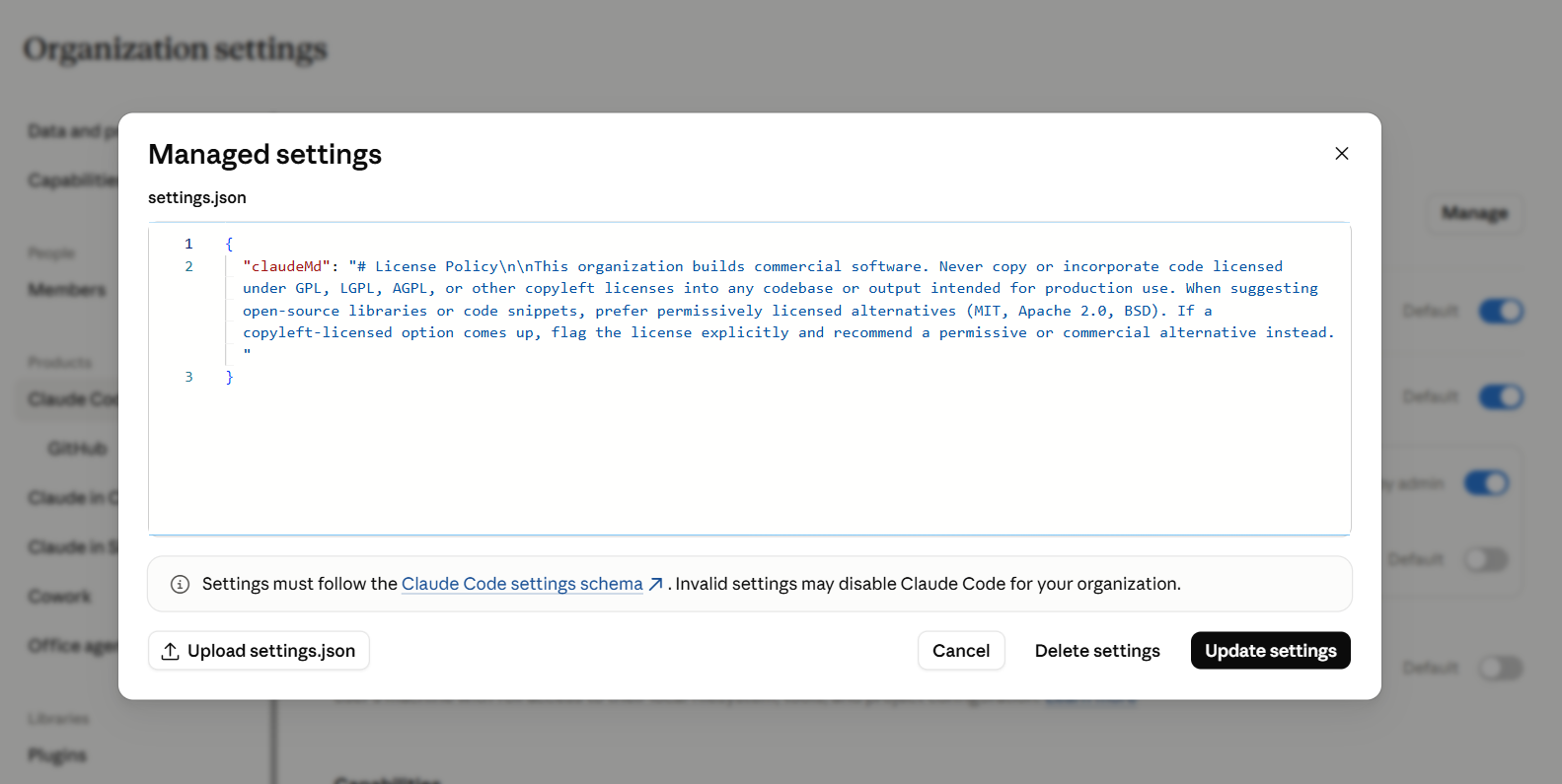
The first level of protection is technical limitations. Enterprise subscriptions for major platforms, like OpenAI and Anthropic, enable organization-level instructions that let you set up marking of copyleft-licensed code and reduce snippet length by a set number of characters. This combination provides a robust basis.
An example of Claude Code instruction
Another layer is well-managed delivery processes. When developers work with AI tools with distinctive requests, conduct regular reviews, and avoid lazy prompts like ‘Code this feature but in Node.js’, the risks of accidental insertion of licensed code into final builds decrease and commonly manifest themselves in negligible pieces.
UKAD’s approach to AI governance
As active adopters of AI-assisted development, the UKAD team has established an approach that enables us to combine accelerated delivery with legal safeguards. We recognize that when AI is involved, eliminating every intellectual property risk is impossible. Instead of investing disproportionate effort into achieving marginal improvements, we focus on the governance measures that have the greatest practical impact.
First and foremost, our workflows are fundamentally human-centric. We use AI to handle code generation and routine tasks, freeing up our engineers' time for technical decision-making, business logic implementation, and rigorous quality control. Simply put: we provide engineering instead of raw coding. For our partners, this means receiving software that remains a product of human intellectual effort and is therefore eligible for copyright protection.
We also rely exclusively on enterprise-grade AI platforms, configured with organization settings that prohibit the insertion of copyleft-licensed code. Within our environment, introducing a GPL-protected snippet into the production codebase is highly unlikely by design. Additionally, we configure our AI tools to automatically include comments regarding the licenses of any code snippets or libraries used. This allows our engineers to easily audit sources during code reviews, catch accidental insertions, and make well-considered decisions.
Finally, we rely on AI providers' policies. Both OpenAI and Anthropic state that customer inputs are not used to train their models under enterprise agreements, while customers retain rights to both their inputs and generated outputs in accordance with those agreements. Combined with our human-led development process, these safeguards help ensure that the software we deliver remains commercially valuable, legally defensible, and suitable for enterprise use.
Final words
Today, compliance has become more than a few lines in standard agreements drafted by a lawyer. Legal safeguards are only effective when supported by delivery processes and technical controls, and all of them won’t work without an ownership-oriented mindset and conscious approach to development. Effective governance and risk mitigation draw the line between just an AI-fast vendor and a reliable partner, providing effective AI-assisted development services. Because in enterprise software development, the real competitive advantage isn't simply using AI; it's using it responsibly.
Artem Bezvesilnyi
Marketing manager at UKAD
Artem is a highly skilled and strategic Marketing Manager with a deep understanding of brand growth, digital trends, and consumer engagement. With a sharp analytical mind and a passion for innovative marketing, he crafts compelling campaigns that drive results. Always ahead of the curve, Artem combines creativity with data-driven strategies to elevate brands and connect with audiences effectively.
Share article
Rate this article!
Your opinion matters to us
Rating: 5.0/5
To rate this article, please accept cookies
We use a unique identifier and IP address to prevent duplicate voting and maintain fairness. This requires storing a small cookie on your device.
Explore more insights
Interested in how we approach similar challenges? Discover other articles on: